
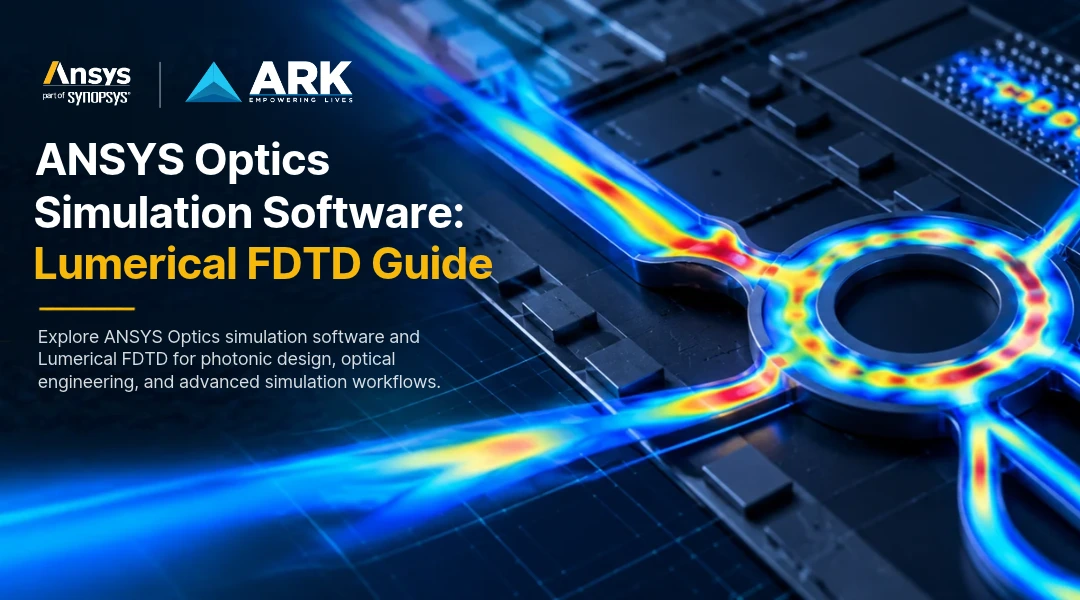
Explore ANSYS Optics simulation software and Lumerical FDTD for photonic design, optical engineering, and advanced simulation workflows.

Introduction
The demand for advanced optical technologies is growing across industries such as telecommunications, semiconductor manufacturing, healthcare, automotive, and consumer electronics. Developing reliable optical components requires accurate analysis of light behavior, material properties, and device performance. ANSYS Optics simulation software helps engineers and researchers explore these challenges through advanced computational modeling and virtual prototyping.
One of the key solutions in the Ansys Optics portfolio is Ansys Lumerical FDTD, a powerful photonic simulation software designed to model photonic components, materials, and processes. It enables engineers to study electromagnetic behavior of the light at the nanoscale and optimize optical designs before moving toward physical prototyping.
What Is ANSYS Lumerical FDTD?
Ansys Lumerical FDTD is a simulation tool based on the Finite-Difference Time-Domain (FDTD) method, which is used to analyze light propagation and electromagnetic interactions within photonic structures. The software provides an integrated design environment with scripting capabilities, optimization methods, and advanced post-processing tools.
By using FDTD simulation, engineers can investigate how light interacts with different materials and geometries. This supports the design and evaluation of photonic devices, including optical components, waveguides, diffraction gratings, metasurfaces, and other nanoscale structures.
Lumerical FDTD also integrates FDTD, RCWA (Rigorous Coupled Wave Analysis), and STACK solvers, allowing users to select suitable simulation approaches for different optical design requirements.

Key Features of ANSYS Optics Simulation Software
1. Advanced Photonic Simulation
Ansys Lumerical FDTD supports accurate electromagnetic analysis of complex photonic components. Engineers can study optical fields, transmission, reflection, and device performance to improve their designs.
2. Multiphysics and Multiscale Workflows
Optical systems may interact with thermal, electrical, and mechanical effects. Ansys Optics provides interoperability and workflows that support Multiphysics and multiscale design, helping engineers analyze complex engineering challenges.
3. Design Optimization and Automation
The software includes scripting, optimization methods, and photonic inverse design capabilities. These features help users explore design alternatives, improve targeted performance metrics, and automate repetitive simulation tasks.
4. Scalable Computing
Lumerical FDTD supports high-performance computing (HPC), GPU acceleration, and cloud-based computing options. These capabilities can help organizations handle computationally demanding photonic simulation workflows.

Applications of ANSYS Optics
ANSYS Optics simulation software can be used in several advanced engineering applications. These include photonic integrated circuit (PIC) development, optical sensors, CMOS image sensors, optical coatings, diffraction gratings, metasurfaces, and semiconductor-related optical design.
For organizations working on next-generation optical technologies, simulation helps evaluate design concepts and understand optical behavior before manufacturing. This can support virtual prototyping, design exploration, and the development of optimized photonic components.
Why Choose ANSYS Simulation Software for Optical Engineering?
Optical engineering often involves complex geometries, nanoscale features, and demanding performance requirements. Simulation-based design provides a way to investigate these factors through computational analysis rather than relying solely on physical prototypes.
With Ansys Lumerical FDTD and related Ansys Optics solutions, engineers can work with advanced optical modeling techniques, optimization workflows, and computing resources. The appropriate simulation method depends on the device, wavelength range, material properties, and engineering objectives.

Conclusion
ANSYS Optics simulation software offers advanced capabilities for engineers and researchers working in photonics and optical design. Ansys Lumerical FDTD, supported by additional optical solvers and optimization workflows, helps users analyze photonic components, explore innovative designs, and develop solutions for emerging technologies.
Whether you are working on photonic integrated circuits, optical sensors, metasurfaces, or semiconductor applications, understanding optical simulation can support more informed engineering decisions.
Explore Ansys simulation software and discover how advanced photonic design solutions can support your engineering and research requirements.
Contact ARK Infosolutions at ansys@arkinfo.in to learn more about Ansys simulation solutions and explore suitable software options for your organization.