Formlabs 3D Printers for Faster Automotive Prototyping in India
India’s automotive industry is evolving rapidly, driven by electric vehicle (EV) innovation, shorter product development cycles, and the growing need for localized manufacturing. For automotive engineers, the challenge is clear: how can designs be tested, refined, and validated faster without increasing development costs?
Traditional prototyping methods such as CNC machining, vacuum casting, and outsourced tooling remain essential. However, frequent design changes can make early-stage prototyping time-consuming and expensive. This is where additive manufacturing is transforming automotive product development.
From Prototype Delays to Faster Iteration
3D printing enables engineering teams to turn digital designs into physical parts quickly, reducing dependence on external vendors for every design revision.
Instead of following the traditional cycle of design, outsource, wait, and modify, teams can produce multiple iterations, identify design issues earlier, and improve components before committing production tooling.
The real advantage is not just faster prototyping—it is the ability to test more ideas, make informed decisions, and accelerate product development.


Why SLA and SLS Matter in Automotive Engineering
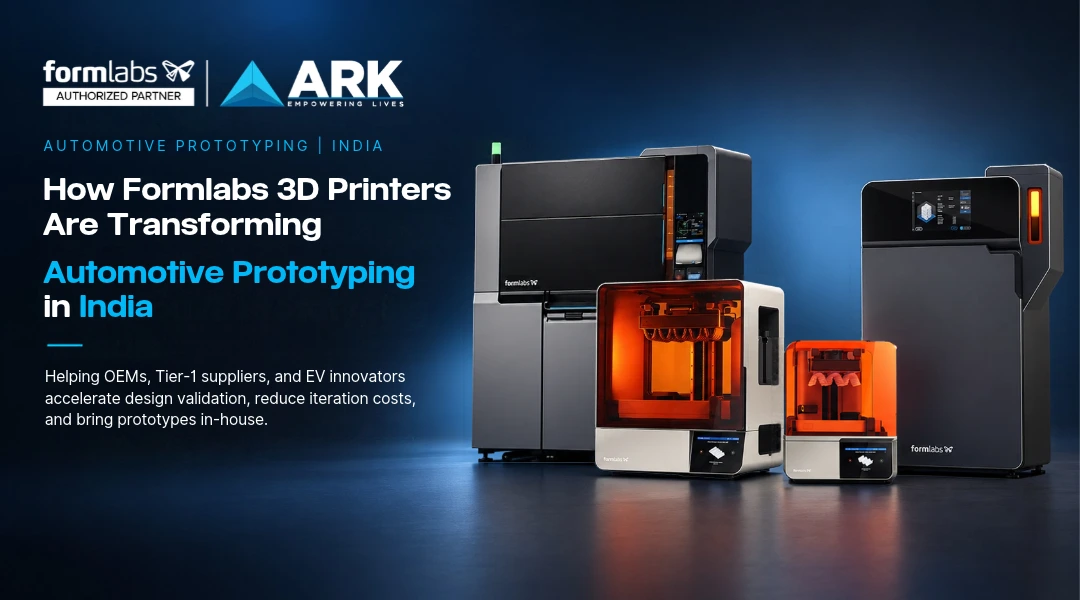
Formlabs 3D printers offer technologies suited to different prototyping requirements.
Stereolithography (SLA): Ideal for detailed prototypes requiring fine features, smooth surfaces, and dimensional accuracy. Depending on the material, SLA parts can support fit checks, assembly validation, and functional evaluation.
Selective Laser Sintering (SLS): Produces durable polymer parts with complex geometries without traditional support structures, making it suitable for functional prototypes, enclosures, and selected manufacturing aids.
With a range of engineering materials available, these technologies can support applications requiring toughness, rigidity, flexibility, or resistance to elevated temperatures, depending on the selected material and testing conditions.


Supporting EV Innovation and Manufacturing Efficiency
As EV development accelerates, manufacturers need to evaluate new designs for battery systems, motor housings, electrical enclosures, connectors, lightweight structures, and thermal-management concepts.
Additive manufacturing helps teams develop and evaluate these designs while also supporting:
Fit, assembly, and ergonomic validation
Functional prototypes and component interfaces
Customized jigs, fixtures, and manufacturing aids
Low-volume and customized components
Design communication across engineering and manufacturing teams
By bringing selected prototyping activities in-house, manufacturers can also reduce vendor dependency and gain greater control over development timelines.
The Business Case for Rapid Prototyping
The cost of a prototype goes beyond manufacturing. It includes setup, transportation, vendor coordination, engineering time, and the expense of producing revised versions.
Reducing iteration time and cost allows teams to explore more design alternatives and identify potential problems earlier. For automotive startups, design consultancies, and Tier-1 and Tier-2 suppliers, this can support faster validation and more efficient product development.
While conventional manufacturing remains important for many production requirements, 3D printing offers a valuable complement throughout concept development, design validation, functional prototyping, and selected low-volume applications.
The Road Ahead for Automotive Prototyping in India
As India's automotive industry embraces EVs, customization, and localized manufacturing, the ability to move quickly from digital design to physical validation is becoming increasingly important.
Formlabs 3D printing solutions help engineering teams explore new designs, evaluate components, and iterate more efficiently. The opportunity lies not simply in printing parts, but in identifying where additive manufacturing can remove time, cost, and complexity from the development process.